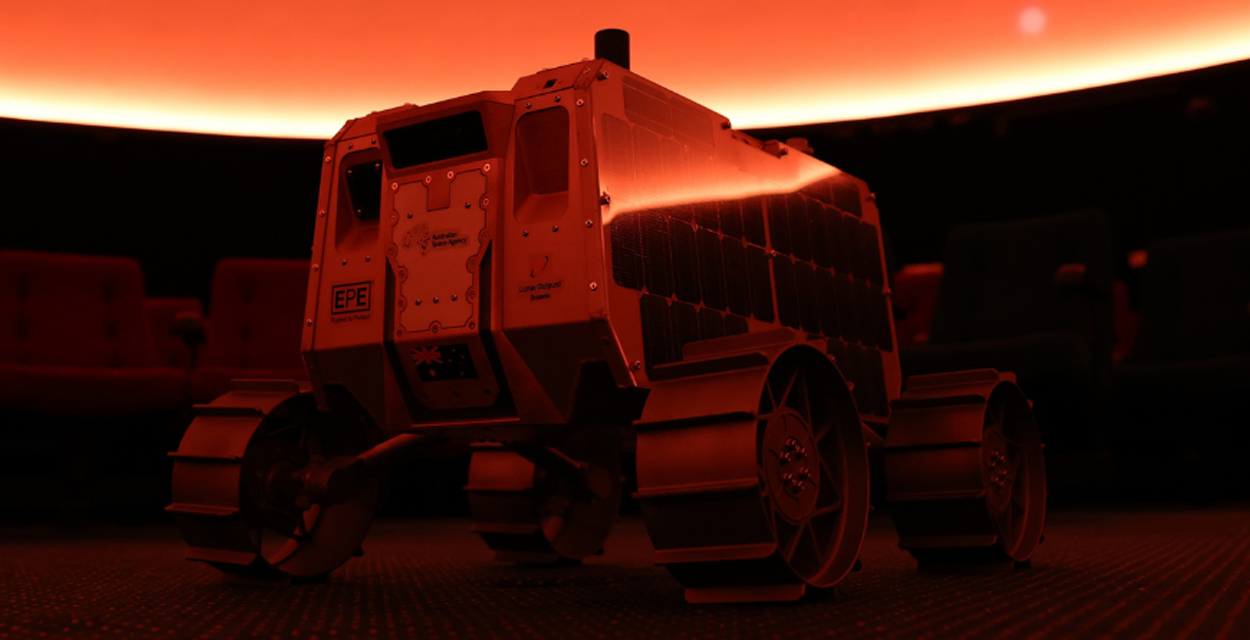

Australia’s ambitions in space have taken another giant leap forward with the unveiling of the latest model of Roo-ver, the country’s first lunar rover.
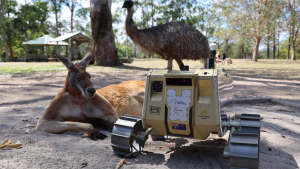
An image of Roo-ver. Courteous of Australian Space Agency.
Revealed during World Space Week 2026 at the Queensland University of Technology’s Lunar Testbed and Space Lab, the new prototype offers the public its clearest view yet of the rover’s design, scale, and capabilities as it moves towards a planned mission to the Moon’s South Pole in 2030.
The unveiling marks a significant milestone in one of Australia’s most advanced engineering and robotics projects to date. Roo-ver is more than just a rover. It represents Australia’s entry into a new era of space exploration and demonstrates the nation’s growing expertise in advanced manufacturing, robotics, autonomous systems, and remote operations.
Over the coming years, engineers and researchers will continue testing and refining a series of prototypes and development models. Each iteration is designed to improve performance and ensure the final rover can withstand one of the harshest environments known to humanity: the lunar surface.
Australian Space Agency Head Enrico Palermo described the project as a symbol of the nation across science.
“Roo-ver is a representation of Australian ingenuity and innovation. With our sights set on 2030, the countdown is on as we continue testing and refining Roo-ver so it’s ready for its historic journey to the Moon. Australia, this is your lunar rover.”
– Enrico Palermo, Australian Space Agency Head.
Built in Australia, Bound for the Moon. The rover will travel to the Moon aboard a future NASA Commercial Lunar Payload Services (CLPS) mission. Once it lands, operations will be conducted remotely from Australia, showcasing a capability that has deep roots in the country’s mining and resources sectors.
Australia has long been recognised as a global leader in remote operations technology, and Roo-ver will demonstrate how those skills can be applied far beyond Earth. The mission also strengthens Australia’s contribution to the international effort to establish a sustained human presence on the Moon through NASA’s Artemis program.
Roo-ver’s primary scientific objective will be to assist NASA in studying lunar regolith, the layer of loose rock and dust covering the Moon’s surface. The rover will carry a NASA payload designed to analyse these materials, helping scientists better understand how lunar resources could support future exploration missions and long-term human habitation. The mission is expected to provide valuable insights into resource utilisation, a key pillar of future lunar exploration strategies.
Beyond its scientific role, Roo-ver will serve as a showcase for several home-grown technologies that have been specifically engineered for the challenges of operating on the Moon. Among the innovations are:
- Thermal Management Systems
Developed to withstand the Moon’s extreme temperature fluctuations, the system must operate in conditions ranging from a freezing -246°C to a scorching 121°C. - Dust and Radiation Protection
Lunar dust is notoriously abrasive and electrostatically charged, while radiation exposure remains a constant threat. Australian researchers have developed technologies aimed at mitigating both hazards, improving reliability and longevity for lunar equipment. - Advanced Lunar Mobility
Roo-ver features specially designed wheels equipped with exterior grousers, allowing it to maintain traction across the Moon’s loose and dusty terrain.
Together, these technologies could play an important role in future lunar missions and highlight Australia’s growing contribution to the global space sector. The project is being delivered through a partnership between the Australian Space Agency and the Roo-ver Consortium, bringing together industry leaders, researchers, universities, and government organisations from across the country.
This collaborative approach has enabled Australia to tackle an ambitious challenge that extends well beyond a single rover mission. The knowledge, technologies, and expertise developed through Roo-ver are expected to create opportunities across space, robotics, manufacturing, and remote operations industries.
The latest Roo-ver model is not the final version destined for the Moon, but it provides an exciting glimpse into Australia’s future in space. As testing continues, the rover is steadily progressing towards what could become one of the most significant achievements in Australian scientific and technological history. With the clock now counting down to 2030, Roo-ver stands as a powerful reminder that Australia’s space ambitions are no longer a distant dream. They are taking shape, one prototype at a time, on a journey that will eventually place Australian technology on the lunar surface.
Australia’s Moon rover is coming. And for the first time, the Moon will feature a rover designed, built, and operated from Down Under.